


TL;DR
Somewhere around chapter 20, you will confidently write a scene where two characters meet for the first time. Your beta reader will politely inform you they already met in chapter 7. You will not remember chapter 7. This guide fixes that with character profiles, relationship mapping, arc tracking, and tools that make it automatic.
For any novelist trying to figure out how to organize characters in a novel, the answer is humbling: even the best in the world needed help.
Brandon Sanderson hired a full-time continuity editor just to track his characters across 40 novels. Robert Jordan’s Wheel of Time has 2,782 named characters, and his editorial team spent decades managing them. J.K. Rowling planned Harry Potter with handwritten spreadsheets tracking every subplot, every character arc, and every secret across all seven books.
These are professionals. With systems. And they still struggled.
Your imagination scales faster than your memory. The moment your cast hits double digits, the human brain starts losing threads. You don’t need a team. But you do need a system. This guide gives you exactly that.
Why This Is Actually a Reader Problem (Not a Writer One)
Here’s something most writing advice gets wrong: they frame character organization as a writer’s problem. Something that makes your life easier. A productivity hack.
It’s not. It’s a reader experience problem.
Readers are detectives. They’re not passively absorbing your story. They’re building a mental model of your world, cross-referencing every new detail against everything they’ve already read. They notice when your protagonist’s scar switches sides. They remember that a character was supposed to be somewhere else when the letter arrived. They catch you in ways you will never catch yourself.
“The single biggest continuity error I see in manuscripts is characters knowing information they shouldn’t have, or not knowing information they should. Writers lose track of who was in which scene, who overheard what conversation, and who’s met whom.”
This breaks something deep in the reading experience. It’s not just an error. It’s a signal that the author wasn’t paying full attention to their own story. And once a reader feels that, trust erodes.
Character disorganization causes three specific failures, all of which readers feel even when they can’t name them.
Continuity errors. Physical details that contradict themselves. Knowledge that appears from nowhere. Characters in the wrong place at the wrong time. These break reader trust instantly and they show up in reviews in the form of “the author clearly didn’t proofread this.”
Cardboard secondary characters. When you lose track of who someone is between appearances, they show up, serve the plot, and feel interchangeable. Readers experience this as flatness. The story feels populated but not alive. There’s a difference, and readers know it instantly.
Broken promises. You plant a detail in chapter 3, a scar, a grudge, a specific skill, intending to pay it off in chapter 30. You forget. The plant rots. The reader who noticed it feels quietly cheated, even if they can’t explain why. These are the readers who write “the ending felt unearned” in their reviews.
Think about how Rowling handled Neville Longbottom. His arc from bumbling first-year to the boy who destroyed the final Horcrux was seeded across all seven books, across hundreds of small moments. That payoff only lands because every plant was tracked and honoured. Drop one and readers feel it, even if they can’t name what’s missing.
The good news: all three failures are solved by the same thing. Track the right details at the right depth.
The Minimum Viable Character Profile
Here’s the counterintuitive truth that will save you weeks of wasted work: the more detail you add to a character profile before writing, the less useful that profile becomes.
Patrick Rothfuss has talked about how Kvoته evolved dramatically during drafting. Sanderson has spoken about characters who took multiple books before he truly understood them. The profile isn’t the character. The character is discovered through the writing. The profile is just a net to catch the details you’ll otherwise lose.
Track the minimum you need to stay consistent, organized by how much page time each character actually gets.
Tier 1: Protagonist and Major Characters
Anyone appearing in more than 10 scenes needs:
Category | What to Track | Why It Matters |
Basics | Name, age, occupation | Consistency in dialogue and narration |
Physical | 3 to 5 distinctive features only | Avoid contradicting yourself |
Internal | Core want, core fear, fatal flaw | Drives every decision they make |
External | Current goal in the story | Keeps every scene purposeful |
Voice | 2 to 3 speech patterns or verbal tics | Makes dialogue instantly recognizable |
Relationships | Connection to every major character | Prevents floating, purposeless characters |
The most important thing to track isn’t what your character looks like. It’s what they want. Snape’s entire arc across seven Harry Potter books flows from a single want he carries from childhood. Rowling knew that want before she wrote page one, and it shaped every scene he appeared in. Get the want right and motivation becomes automatic. Get it wrong and every scene becomes a struggle.
Tier 2: Supporting Characters
Characters appearing in 3 to 10 scenes need:
Name, role, relationship to protagonist
1 to 2 distinctive physical features
Their function: information source, obstacle, support, or comic relief
Which chapters they appear in
Tier 3: Minor Characters
One-scene wonders need only three things: a label or name, the chapter they appear in, and one visual detail. Think of the way Rowling described even the most minor Hogwarts teachers with one physical quirk or personality detail. None of them feel generic. That’s not magic. That’s discipline.
Writeo
Writeo’s character profiles come with built-in section templates, Physical Appearance, Background, RPG Stats and more, so you’re never staring at a blank page. Build and save your own too, reusable across every character. Start free at writeo.app
Tracking Physical Descriptions: Less Is More
Here’s the mistake: writers track too many physical details, which paradoxically creates more continuity errors. The more you write down, the more you have to stay consistent with across 80,000 words. Most of it will never come up again.
The goal isn’t a complete physical inventory. It’s a contradiction shield.
The Three Anchor Method
For each major character, pick exactly three physical details that:
Are mentioned more than once in the manuscript
Could realistically be contradicted if you forget them
Actually mean something to the character or their story
Harry Potter’s lightning bolt scar is the single most famous example of a physical detail doing enormous narrative work across seven books. It appears constantly, carries plot significance, connects to his identity, and ultimately explains everything. Rowling didn’t track thirty physical details about Harry. She tracked the ones that mattered.
Your version of that for a character named Elena might look like this:
Anchor | Detail | Why It’s on the List |
Hair | Silver-streaked black, always braided | Reveals her age and practical nature |
Scar | Thin line across her left palm | Plot-relevant, from the incident in her backstory |
Movement | Slight limp | A constant visual reminder of the accident |
What didn’t make the list: her eye color (never mentioned again), her height (irrelevant to the story), her clothing (changes scene to scene). The details that make the cut are the ones that carry narrative weight.
Track these: Eye color, hair color and style, scars or tattoos, physical disabilities or injuries, age if significant time passes.
Don’t track: Exact height or weight, generic clothing, any physical detail mentioned only once.
Mapping Character Relationships: The Part That Actually Matters
George R.R. Martin’s A Song of Ice and Fire, the books behind Game of Thrones, runs on knowledge asymmetry. Cersei knows something Ned doesn’t. Littlefinger knows something Cersei doesn’t. Jon doesn’t know something the reader does. Every major character operates on incomplete information, and Martin tracks exactly who knows what at every point in the story.
Harry Potter works the same way. Harry doesn’t know Snape loved his mother. Dumbledore knows Harry must die and says nothing for six books. Ron and Hermione don’t know about the Horcruxes until Harry tells them. The entire series is built on characters operating with different pieces of the same puzzle, and Rowling tracked every piece across seven books using handwritten spreadsheets that mapped each subplot chapter by chapter.
That asymmetry, who knows what about whom and when they learned it, is where the real continuity errors live. Not in eye colors. In knowledge.
Who told Ron about the Horcruxes? Was Hermione in the room when Dumbledore gave Harry those instructions? Does Snape know what Harry suspects? These are the questions that blow up your plot in revision if you haven’t tracked them.
Start With a Simple Matrix
For casts of 5 to 15 characters, a quick grid gives you instant visibility into your story’s social landscape:
Harry | Hermione | Ron | Snape | |
Harry | — | Trusts completely | Best friends | Despises (doesn’t know the full truth) |
Hermione | Trusts completely | — | Close friends (complicated) | Respects academically, fears |
Ron | Best friends | Close friends (complicated) | — | Despises |
Snape | Actively undermines | Tolerates | Despises | — |
Two things jump out immediately: Ron and Hermione’s relationship is complicated in a way that’s never quite resolved, that’s tension Rowling tracked across six books before paying it off, and the Harry-Snape dynamic is completely asymmetric, Harry despises someone who is secretly protecting him. The matrix doesn’t just help you track. It helps you write.
Then Go Visual
Once your cast grows past 15 characters, or once the relationships get complex enough that a grid can’t capture them, you need to see the whole web at once.
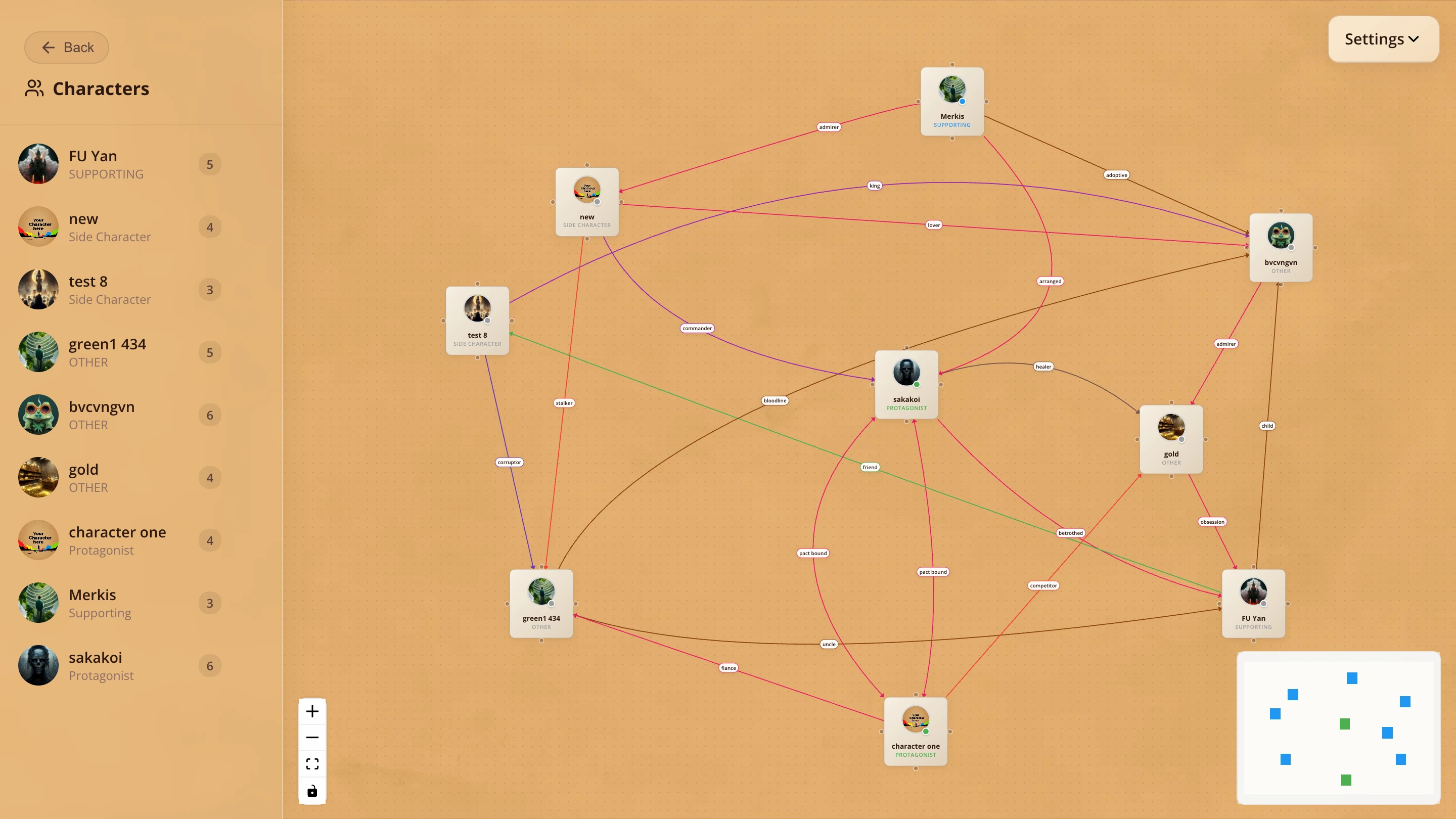
Writeo’s Character Relationship Visualizer maps your entire cast as a live interactive graph. Connections are color-coded by type, thickness shows intensity, and secret relationships appear as dashed lines. The moment you build this for a complex story, something clicks. You stop thinking about characters as a list and start thinking about them as a system.
You see the clusters. You see the isolated characters who need more connections. You see the overloaded protagonist who’s tied to everyone and might need some threads redistributed. It changes how you think about your story, not just how you organize it.
The Part Everyone Skips: Tracking How Relationships Change
Here’s where even organized writers fall apart.
Think about the Jaime Lannister and Brienne of Tarth relationship in A Song of Ice and Fire. It starts as contempt. It shifts slowly, through shared hardship and forced proximity, into something resembling respect, and then something harder to name. Martin doesn’t just know where those characters end up. He knows every beat that gets them there, and what caused each shift.
Or think about Harry and Dumbledore. Book one: awe and gratitude. Book five: suspicion and resentment. Book seven: grief, understanding, and a complicated love. That arc doesn’t happen by accident. Every shift was planned, tracked, and paid off at exactly the right moment.
Most writers track where relationships start. Almost nobody tracks how they evolve, which chapter the shift happened, what caused it, what the before and after looked like. Then they wonder why the reconciliation scene in chapter 28 doesn’t land. There was no documented road from enemies to allies. The writer forgot the steps. The reader feels the jump.
Writeo’s Evolve feature lets you record every shift as it happens. What changed, why, and which chapter it occurred in.
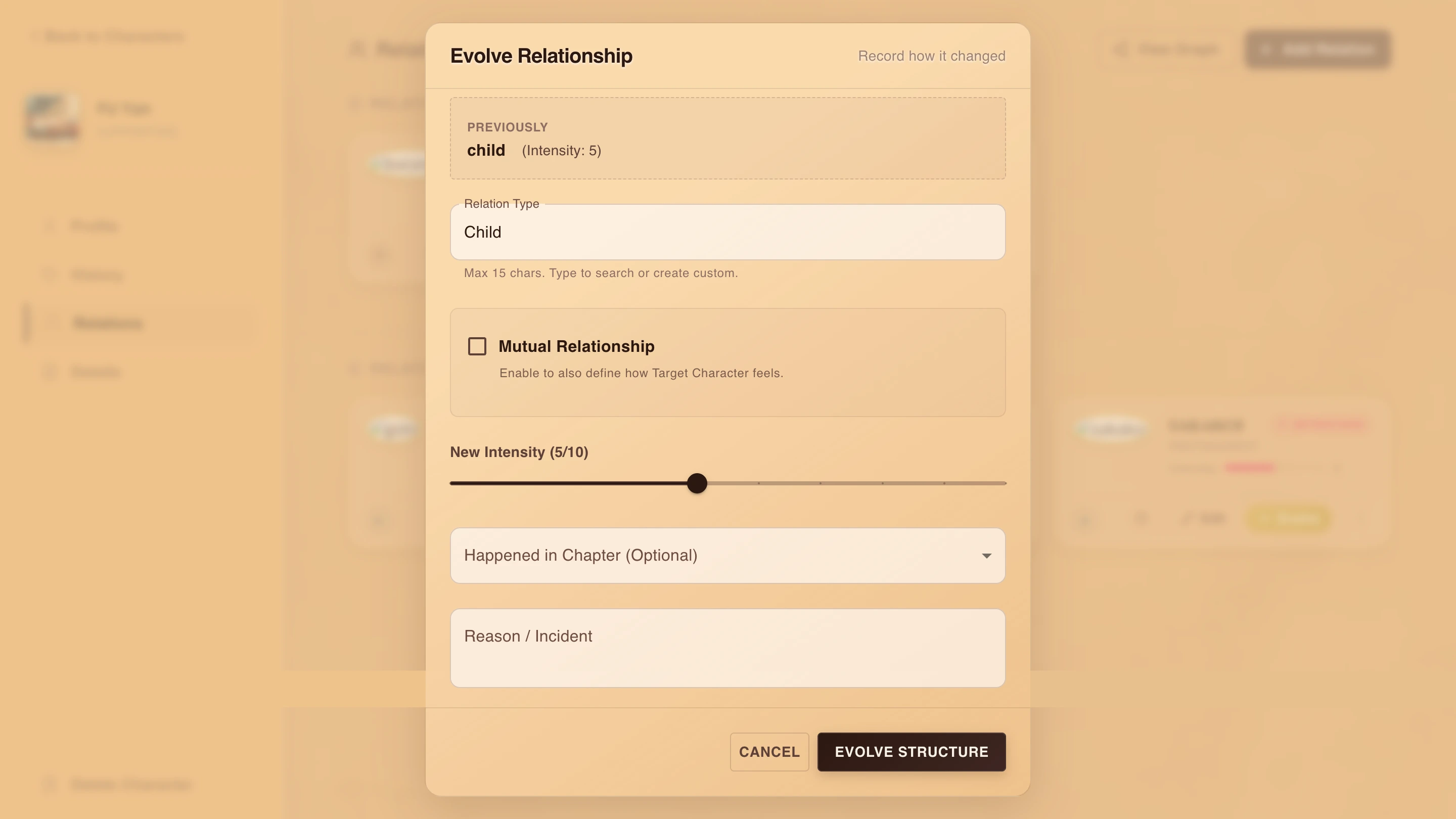
Every evolution is logged in a Relationship Timeline, a permanent history of every change made to that connection, with your notes attached.
This is what prevents relationship whiplash. When a reader asks “wait, when did they become friends?” you have the receipts, chapter by chapter, with the reason attached.
Tracking Character Arcs Without Drowning in Spreadsheets
A character who doesn’t change is a prop. But tracking exactly how someone evolves across 80,000 words is where most manual systems collapse under their own weight.
The writers who do this best don’t track everything. They track state changes. Where is this character emotionally at the start of each major act, what pushed them from one state to the next, and where do they land?
Think about Zuko in Avatar: The Last Airbender. His arc is legendary not because it’s dramatic but because it’s earned. There are setbacks. There are moments of regression. Every shift is caused by something specific. The writers clearly knew exactly where he was at every point in the story.
Rowling did the same with Neville. Every book added one small piece to his arc, quietly, without drawing attention to it, until the moment in the final book when all those pieces snapped together. That doesn’t happen by accident. It happens because someone was tracking it.
Writeo’s Character History tab does this automatically. You create a character once and from that point the editor tracks their appearances and mention counts across every chapter without you lifting a finger. For every character you can see exactly which chapters they were active in and how often they appeared.
The warning sign no one talks about
If a character disappears for ten or more chapters and then reappears for a major emotional scene, readers will have mentally filed them away. That scene won’t land the way you need it to. The history tab catches this before your beta readers do.
Managing Large Casts: Two Things That Actually Work
The One-Line Test
Every named character in your novel should survive this: can you summarize them in one sentence? Not their backstory, their function and tension.
Run this test on any Harry Potter character and it works instantly:
Hagrid: The giant-hearted keeper who gives Harry his first real sense of belonging.
Luna Lovegood: The oddly perceptive outsider who sees truth others dismiss as nonsense.
Neville Longbottom: The boy everyone underestimates, including himself, until it’s too late.
Draco Malfoy: A bully shaped entirely by a world that told him he was superior, slowly discovering he isn’t.
That’s not accidental. That’s tracking. Every character has a function and a tension, and Rowling never lost sight of either.
If a character in your novel can only be described as “the protagonist’s coworker who appears in a few scenes,” that character either needs a reason to exist or needs to be cut. Two characters serving the same story function is one character too many.
Run this test on your entire cast right now. The characters who fail it are the ones your readers are already forgetting.
Track Aliases Too
This catches fantasy and thriller writers constantly. Your character has a given name, a title, a nickname, a pseudonym, and what the villain calls them in private. Readers track all of these. You’ll forget half of them by chapter 15.
Rowling managed He-Who-Must-Not-Be-Named, You-Know-Who, the Dark Lord, and Voldemort across seven books, all referring to the same character, all carrying different emotional weight depending on who was speaking. Every alias did a job. None were interchangeable.
Writeo’s Alias Manager lets you register every alias. The editor then tracks all of them automatically, same as the main name, so nothing slips through.
Tools: An Honest Comparison
Tool | Best For | Limitation | Price |
Writeo | Visual relationship mapping and automatic character tracking | Web only for now | Free tier |
Scrivener | Long-form writing with attached research notes | No visual mapping, steep learning curve | $49 one-time |
Notion | Flexible custom databases | Manual setup, no visualization | Free tier |
Spreadsheets | Simple tracking for small casts | Falls apart fast past 10 characters | Free |
The fundamental problem with spreadsheets and Notion is that they’re disconnected from your writing. Every update is a separate task you have to remember. With Writeo, you create a character once and the editor tracks their appearances and mention counts automatically from that point on. Relationship evolution you log yourself, but when you do, it lives in a permanent timeline attached to that relationship. Not buried in a folder you’ll never find at 1am during revision.
5 Mistakes That Will Cost You in Revision
1. Over-profiling before you write. Three months of backstory for a novel you haven’t started will change completely once you meet these people in the draft. Profile minimally before. Expand aggressively after.
2. Tracking appearance but not knowledge. The most common continuity errors aren’t physical. They’re informational. Who was in the room. Who overheard what. Who was lied to, and when. Track knowledge with the same care you track eye color.
3. Treating profiles as a snapshot, not a living document. A profile that doesn’t update as your story develops gives you false confidence. It tells you who your character was at the start, not who they’ve become 60,000 words later. Review and update after every major draft milestone.
4. Ignoring minor characters. The bartender in chapter 4 who reappears in chapter 39 will betray you if you didn’t write down the one detail readers will remember about them. Keep a running list of every named character, even one-scene wonders.
5. Tracking relationship states but not relationship changes. Knowing two characters are enemies tells you where they stand. Not knowing how they got there is why your reconciliation scene won’t land. The journey matters as much as the destination.
Questions Writers Actually Ask Mid-Novel
My beta reader says my characters feel “flat.” What does that actually mean?
It usually means the character serves the plot but has no life outside of it, or they react the same way to every situation. The fix is almost never more backstory. It’s adding contradiction. A loyal character who lies once. A brave character who hesitates at the wrong moment. Flatness disappears the moment a character surprises you, which only happens when you know them well enough to know what would genuinely surprise them.
I’m 60,000 words in and my characters feel inconsistent. Do I have to rewrite everything?
No. Finish the draft first, always. Then do a dedicated character pass before anything else. Go through the manuscript character by character, not chapter by chapter. Read every scene that character appears in, back to back. Inconsistencies jump out immediately when you’re reading one character’s continuous thread instead of moving linearly through the plot.
How do I stop introducing characters readers immediately forget?
Give every new character one unforgettable detail and one surprising moment in their first scene. Not a description paragraph, not a backstory dump, one moment. The guard who’s secretly terrified of birds. The healer who flinches at the sight of a specific flower. Readers remember moments, not descriptions.
My protagonist is connected to every character in the story. Is that a problem?
Usually yes. When the protagonist is everyone’s best friend, rival, mentor, and love interest simultaneously, two things happen: they lose specificity, and secondary characters stop having lives that exist independently. Give at least two characters a meaningful relationship with each other that doesn’t involve your protagonist at all. It makes the world feel real instead of protagonist-shaped.
When is the right time to start tracking characters?
Earlier than you think you need to. The cost of setting up a system is an hour. The cost of not having one is weeks of revision untangling mistakes a simple note would have prevented. Most writers start around chapter 10 when things get complex. Start at chapter one.
Start Here, Before Chapter 20
You don’t need a perfect system. You need one that’s running before the complexity hits.
Three things to do today:
Write a one-line summary for every named character currently in your manuscript
Map the five most important relationships, just a quick grid, who knows what about whom
For each of those relationships, note one thing that changes it and which chapter it happens in
That’s your foundation. Build from there as your story demands.